Home » 2014 (Page 3)
Yearly Archives: 2014
Lee Grant’s ‘I Said Yes to Everything’: A Book Review
 If, like me, you spent the 1970s glued to ‘The ABC Sunday Night Movie,’ then the name Lee Grant probably conjures up images of all-star casts, international intrigue, and blockbuster drama.
From Neil Simon’s “Plaza Suite” to “Voyage of the Damned” to “Airport ’77,” Grant appeared alongside the biggest names in Hollywood, in some of the best films ever made.
For a period of time, you couldn’t turn on a television without hearing broadcast announcer Joel Crager’s baritone voice reciting a who’s-who list of movie stars, ending with the familiar refrain “…and Lee Grant starring in…”
This explains why Grant’s new autobiography “I Said Yes to Everything” is a book I’ve been waiting years for her to write.
Beginning with dreamy childhood memories and ending with a celebratory Christmas dinner in 2013, Grant takes us through her life’s arc with all the passion and candor that one could hope for. There’s an artfulness to her prose, a sense of adventure and revelation in the way she structures the tale. Not one to run from a fight or hold her tongue, Grant writes with a clarity and self-deprecating honesty that’s rare these days. From boldly confessing her deepest fears, weaknesses, and vanity, to exposing embarrassing moments like the time she visibly got her period on stage during an opening night performance – and kept right on acting – this is the memoir of an artist with nothing left to hide.
The fact that she does it all with a ribald sense of humor and razor-sharp intelligence makes it that much sweeter.
There’s a vibrant, sensuous quality to the early chapters set in 1930s New York and France. Grant writes with a child’s eye for detail, painting the sights and sounds of the Bronx and Paris with a heightened intensity that’s impossible to resist. We wince at the vicious anti-Semitism she suffers as the daughter of Jewish/Polish parents, and experience her fumblingly awkward sexual awakenings amid the subways and tenement houses of NYC.
Around this time, we witness the birth of an Academy Award winning actress. From the moment she’s chosen at random while walking across the stage at the Metropolitan Opera House on her way to a children’s ballet class, to her years studying alongside Sanford Meisner and teaching at the famed Actors Studio, Grant takes us step-by-step through her development as a performer.
For fans like me, it’s thrilling stuff.
The twelve years she spent on the Hollywood blacklist forms the most fascinating section of the book. Married to a communist playwright at the time, Grant’s fearless commitment to social justice and her outspoken support of accused fellow artists landed her on the House Committee on Un-American Activities (HUAC) watch list. Just as her career was skyrocketing, offers for film and television roles dried up overnight. The Kafkaesque events that followed eventually destroyed her marriage and threatened her sanity.
And yet, as righteously angry you’d expect her to be, Grant’s story never bogs down in bitterness or blame. The person we find within these pages is far too practical and grounded for that. Although the toll that Joe McCarthy and Roy Cohen exacted was enormous, Grant outlasted her political enemies and reclaimed her career through sheer determination. It’s truly inspiring.
And then there are the larger-than-life personalities she encounters along the way; from a brooding, mercurial Marlon Brando, to a desperate, haunted Lenny Bruce. Grant spills juicy details about illicit romances with Burt Bacharach and Warren Beatty, and sheds sad light on Melvin Douglas and Grace Kelly, both of whom seem lost and tragic by the time she meets them. Best of all are the outrageous stories she tells about the incomparable Shelley Winters. The two actresses worked together on “The Balcony,” and Winter’s narcissistic bullying instantly clashed with Grant’s professionalism. Their uncomfortable rivalry eventually exploded during promotion for the film at the Playboy Club in New York. I won’t soon forget the image of Lee Grant literally chasing Shelley Winters across the grotto screaming “Cunt!” at the top of her lungs.
The final chapters of the book document Grant’s transition from in front of the camera to behind it. At a certain point, the lack of good roles, coupled with a crippling fear of forgetting her lines, forced the actress to reevaluate her career. An article in the news about a group of women on strike against a bank in Minnesota inspired her to document their plight, which is how she added award winning documentarian and filmmaker to her list of credits.
Covering almost 90 years in the rollercoaster life of a gifted artist, “I Said Yes to Everything” is exactly the book I’d hoped it would be. Near the end, Grant hints that there might be a few more stories for a second memoir.
We should be so lucky!
Disney’s ‘Saving Mr. Banks’: A Film Review
 “Saving Mr. Banks” is a well-produced bore about a singularly unpleasant person.
Understand this: I love movies about assholes. Noah Baumbach’s “Greenberg” is one of my favorite films, and I consider Neil LaBute’s “Your Friends and Neighbors” to be a caustic masterpiece. But spending two dullish hours in the company of Mary Poppins’ noxious creator was almost more than I could handle.
Watching it, I was reminded of Roger Ebert’s final line in his review of Brian De Palma’s “Scarface.” He summed up that classic gangster film as “a wonderful portrait of a real louse.”
Well, “Saving Mr. Banks” gets the second half of that quote right.
This is actually two movies crammed into one. The first is set in 1961 and depicts the meeting between author P. L. Travers and filmmaker Walt Disney during pre-production for the adaptation of her beloved novel. The second storyline deals with Travers’ difficult childhood in dusty Australia. These sepia-toned flashbacks are so cliché-ridden, so lacking in honest emotion, so transparently manipulative, they make the animatronic Lincoln robot in Disneyland’s ‘Hall of Presidents’ seem like Daniel Day-Lewis.
Most of the blame lies with a script that mistakes hoary old chestnuts for psychological depth. Colin Farrell does what he can with the stereotypical ‘drunk dad’ role, but everything about the character is so overtly telegraphed it’s an uphill battle. The moment he coughs into a handkerchief, you just know it’s going to come away stained with blood.
Casting is problematic as well. The child-actress who plays the young P. L. Travers is simply not up to the task of portraying a complex human being at this stage in her career. She mostly just stands there, backlit, looking golden and angelic as the sun catches her curly hair just right. She’s little more than a prop, a semi-realistic doll that occasionally mumbles a corny line or two. Perhaps the filmmakers should’ve cut these sequences down to just a few fleeting images, instead of filling the movie with them.
The Disney half of the picture works better, but never quite catches fire. My main qualm is how repetitive it is. When we first meet Emma Thompson as Travers she’s complaining about selling her book to Hollywood. Two hours later, she’s still bitching about it.
The movie just keeps covering the same ground over and over again. While there’s some undeniable fun to be had in watching the birth of a classic like Disney’s “Mary Poppins,” the real-life Travers comes across as uniquely unsuitable for biopic treatment. She’s a one-note figure, almost exactly the same at the end of the story as she was at the beginning. Basically, she’s like Dustin Hoffman’s Rain Man… but not as lovable.
I guess we’re supposed to find her constant insults and cruel remarks “witty.” Instead, I just thought she was a bitter, humorless, nasty piece of work. There’s a pettiness to Travers that no amount of mildewed flashbacks can explain.
Tom Hanks lays on the folksy drawl pretty thick as the creator of Mickey Mouse. Personally, I had trouble believing that his Walt Disney could order his own lunch from the studio commissary, let alone run an empire.
I was surprised at what a small-scale movie this was. Most of the Australian sequences take place in a single drab farmhouse, while the bulk of the Disney scenes are set in one small rehearsal room. The whole thing felt oddly claustrophobic after about an hour.
I’m not exactly sure who the target audience for this is. Certainly not children, as I imagine they’d be bored to tears by it. And I have trouble picturing the modern teen who’d find it enthralling. Maybe it’ll resonate with adults who grew up loving the Poppins book and film, but I doubt it.
My advice for them would be to stick with the originals.
Peter Berg’s ‘Lone Survivor’: A Film Review
 I admire Peter Berg’s “Lone Survivor” on a technical level, and respect the courage and prowess of the real-life soldiers upon whom this true story is based. However, the film’s near-complete lack of characterization, coupled with its torture-porn brutality, made it an endurance test to sit through.
And that’s probably what Berg had in mind.
Like Ridley Scott’s “Black Hawk Down,” this is an ultra-realistic combat simulation that drops the viewer directly in the line of enemy fire. There’s a ‘caught-in-the-crossfire’ intensity to the violence that never lets up once the first bullet leaves its chamber.
Shattered bones are rendered in extreme close-up and shrapnel wounds are documented in near-clinical detail. We’re talking state-of-the-art carnage, created by cinematic craftsmen of undeniable skill.
It’s too bad then that we never learn much about the four main characters who suffer the worst of it. The most I could glean from the film’s brief pre-combat opening is that two of them apparently have wives and fiancés waiting for them back home. Apart from their facial hair preferences, that’s about as in-depth as they get.
Having starred in the war film “A Midnight Clear” (1992) and directed “The Kingdom” (2007) – not to mention the amusingly goofy “Battleship” (2012) – it’s obvious that Peter Berg has a deep admiration for the extraordinary sacrifices soldiers make. So it’s doubly-hard to figure out why he’d invest so little humanity in the main characters, while lavishing enormous effort to show how painfully they died. It’s clear that he wants to honor them with this movie, but I don’t understand how stripping them down to bearded mannequins in a gory shooting gallery accomplishes that. Once they come under attack, we may as well be watching videogame avatars.
The movie’s centerpiece battle lasts a full hour. I wish Berg had carved fifteen minutes from it and added them to the opening section of the film.
Where did these men grow up? Why did they join the military? Do they truly believe in what they’re fighting for? What plans do they have once their mission is over? “Lone Survivor” doesn’t bother to ask those questions, let alone answer them. Instead, we’re treated to a semi-standard ‘Band of Brothers’ philosophy and little else. I don’t know why the producers cast actors like Mark Wahlberg and Emile Hirsch and then gave them nothing to play. These are purely physical performances, the kind that could have been accomplished by any number of charismatic stuntmen.
If we learn very little about the movie’s heroes, we’re given even less info about the Afghanis in the film. In many ways, this is an old-school war movie, the kind that paints every non-American in strictly black and white terms. Some are “good guys,” most are “bad guys,” and we can tell exactly who’s who by how much they scowl. I could overlook this shallowness if even one of the “bad guys” was the slightest bit memorable. But here they’re virtually interchangeable. Investing one of them with a smidgeon of personality might have made the climax seem a bit more exciting. As it stands, the finale is the film’s weakest sequence.
Another problem is that there’s almost no context to the heroes’ mission. We’re told that they’re supposed to identify a high ranking Taliban bigwig, but then what? There’s no larger scope to their task, and very little seems at stake if they fail to complete it. Without a greater sense of risk, or some kind of global urgency, they might as well be a bunch of heavily armed backpackers who got lost behind enemy lines.
The film opens with real-life documentary footage of young recruits training in boot camp, and I have to confess, this felt more than a little exploitative to me, especially once the high-velocity, high-gore action sequences began a short while later. I’m just not sure that “Lone Survivor” is serious enough to warrant its inclusion.
And finally there are the photos of deceased soldiers shown during the end credits. Whoever decided to score this heartbreaking montage with Peter Gabriel croaking out a dirge-like version of David Bowie’s “Heroes” should have picked another song. It’s borderline ghastly.
I’m glad I saw “Lone Survivor,” but I doubt I’ll be seeing it a second time.
Nick Cutter’s ‘The Troop’: A Book Review
 Nick Cutter’s “The Troop” is advertised on its front cover as a “Novel of Terror,” but it’s more like a high-class gore book.
That’s not meant as an insult.
Similarly, the back cover describes it as “28 Days Later” meets “Lord of the Flies,” when it’s actually closer to “Cabin Fever” meets “Bushwhacked.” Again, I’m not putting it down, mainly because… well… I couldn’t put the damn thing down. It’s well paced, tightly written and keeps you turning pages long into the night.
Although not as revolting as Ed Lee’s “The Bighead,” Bryan Smith’s “Depraved” or Wrath James White’s “Succulent Prey” (because it, mercifully, lacks sexual violence), “The Troop” might be the most gleefully grotesque novel that Simon & Schuster has ever published.
Admittedly, there were times when I felt that the gore slowed the story down a bit. I mean, I love movies like Lucio Fulci’s “The New York Ripper” and novels like Richard Laymon’s “Flesh” as much as the next guy, but when “The Troop” paused for three solid pages to depict the graphic slaughter of a sea turtle in agonizing detail… well the book just stopped dead in its tracks. Cutter was clearly making a serious point about the difficulty of killing something that wants so badly to live (mainly because he repeated that point twice in no uncertain terms), but did the turtle scene really have to drag on for so long? Was there no other way to introduce that concept?
The same holds true for a flashback sequence involving the torture of a kitten. The story just screeches to a halt while the graphic details pile up. Moments like these (and there are several others involving self-mutilation and bodily disintegration) might help to distinguish “The Troop” from the mainstream horror pack, but they do so at the expense of narrative momentum.
Aside from those few scenes, however, this is a very fun book. It’s an energetic, over-the-top monster story about five kids trapped on an island while being menaced by killer tapeworms. What’s not to like about that? It’s got a pitch-black sense of humor and a plethora of wonderfully sick images scattered throughout its pages.
I just wish that it had a touch more originality. Scott Smith’s similarly themed novel “The Ruins” had a unique, dreamlike quality that this book lacks. “The Troop” never quite transcends its enjoyable B-movie logline the way that Colson Whitehead’s brilliant zombie novel “Zone One” does. Nor is it interested in subtext or social satire like Chase Novak’s recent pregnancy horror novel “Breed.”
And yet I had a total blast reading it. Highly recommended for horror fans with strong stomachs.
Dario Argento’s ‘Dracula 3D’: A Film Review
 Dario Argento’s “Dracula 3D” isn’t the complete fiasco that virtually every single person who’s seen it is claiming it to be.
Sure, long stretches of it are mind-numbingly boring. Sure, the actor who plays Count D is possibly the least charismatic bloodsucker in the history of cinema. And yeah, a good portion of it is shot so flatly that it’s impossible to detect any 3-D whatsoever.
But every so often there appears on screen something so magically weird, so batshit crazy, so jaw-droppingly “huh?” that I couldn’t help but forgive the film its myriad flaws.
For instance, there’s an eye-popping moment when Dracula transforms himself into a 9 FOOT TALL BRIGHT GREEN PRAYING MANTIS. Top that, Bram Stoker! Plus, it’s got enough old-school gore and gratuitous full-frontal nudity to keep you from falling asleep during the dull bits.
Oh, and Dracula also turns into one of those CGI owls from “Legend of the Guardians: The Owls of Ga’Hoole” at one point.
Best of all, there’s Rutger Hauer as a near-catatonic Professor Van Helsing, pounding giant wooden stakes through vampire chests without using a hammer. His hands are so painfully bloated that he simply whacks ’em with his palms! Seriously, I hope they had a team of doctors on set, because Hauer looked like he was one single malt scotch away from full cardiac arrest.
Factor in a few random axe murders, some guy getting his head split in half by a shovel blade, Renfield portrayed as a hulking mongoloid and a non-stop theremin score borrowed from a Simpson’s “Tree House of Horror” episode and you’ve got an unexpected winner, in my humble opinion.
Review: OMEN IV and OMEN V
 Everyone knows the classic film “The Omen.” Horror fans fondly remember its cinematic sequels, “Damien: Omen II” and “Omen III: The Final Conflict.” Some might even recall the less-than-stellar 1991 made-for-TV movie “Omen IV: The Awakening.” But very few have read the two official paperback novels that continued the adventures of the antichrist during the mid-80s. And that’s a shame, because they’re both worth reading.
“Omen IV: Armageddon 2000” is an enjoyable slice of occult hokum that picks up exactly where “The Final Conflict” left off. Better written than it needs to be, you can practically hear Jerry Goldsmith’s Oscar winning score kick in every time another bizarre murder takes place within its pages. Speaking of murders, this book’s loaded with ’em! The impressive body count rivals the movie franchise in terms of elaborate gore, and the whole thing builds to a downbeat, apocalyptic climax involving Biblical prophecy, war in the Middle East and nuclear weapons. Best remembered for the sleazy method in which Damien’s son is born (wrong orifice, is all I’ll say), “Omen IV: Armageddon” won’t win any prizes for originality, depth or scares… but as a nostalgic example of large-scale Satanic horror, it goes down pretty smooth.
Unfortunately, “Omen V: The Abomination” isn’t quite as strong as its predecessor. Gordon McGill’s writing remains solid, but there’s not much energy left in Damien’s saga by this point in the series. It takes almost 100 pages (out of a scant 219) for an actual Omen-style death to occur, and even then it’s disappointingly humdrum. The body count is low, and far too little happens for most of the story. Damien’s grouchy offspring (unimaginative named ‘Damien II’) makes one last attempt at world domination, while the novel’s hero, a dull Hemingwayesque writer researching a book about the Thorn family, tries to figure out how to work a high-tech word processor. The (anti)climax reads like a watered-down version of the “Omen IV” ending, which was only so-so to begin with.
But the book isn’t a total loss. What’s most interesting about this final chapter is that it takes place after a portion of the planet has been destroyed by nuclear weapons. This places the story firmly in speculative sci-fi territory, and McGill gives us several intriguing glimpses of life in a post-apocalyptic world filled with weird weather patterns, mass starvation, political chaos and religious fundamentalism.
Ultimately, these are two fascinating additions to the official “Omen” canon, and I highly recommend them to all of Damien’s curious disciples.
Pat Conroy’s ‘The Death of Santini’: A Book Review
 As a longtime fan of his purple-prosed fiction, it saddens me to admit that Pat Conroy’s “The Death of Santini” didn’t really work for me. When the book was first announced, I was a bit disappointed to learn that we were getting another memoir instead of a brand new novel. But the thought of Conroy peeling back the layers of his father’s violent personality still held some promise. At least that’s what I’d hoped for. After finishing it, I feel like Pat’s gone back to this autobiographical well once too often.
The opening chapters dealing with his father’s explosive anger and the cruel physical abuse he routinely meted out to his wife and children are the strongest by far. Conroy vividly paints the man as a hair-trigger tyrant who viciously terrorized his family at the drop of a hat. There’s a palpable horror to these early pages, a ‘you-are-there’ intensity that places the reader directly in the path of each oncoming punch. It’s shocking stuff, far worse than Conroy’s fictionalized account in his breakthrough novel “The Great Santini.” Eventually he segues into the making of the classic film starring Robert Duvall, and the strangeness of his life’s journey becomes sort of beautiful, in spite of the pain.
But then the book shifts gears dramatically and Conroy spends an inordinate amount of pages documenting the life of his maternal grandmother, ‘Stanny’, a woman who comes across more as a selfish alcoholic bore, prone to weirdly obnoxious sexual outbursts, rather than the ‘shining glory’ that Conroy repeatedly claims her to be. This is a woman who, during the Great Depression, literally orphaned her four helpless, poverty-stricken children to the care of her mentally deranged husband and took off for parts unknown. Conroy tries hard to forgive this unforgivable act of abandonment by explaining that years later, once she’d comfortably remarried, Stanny sent for her children to join her in Atlanta. But then he lets slip that she spent the rest of her life refusing to accept the legitimacy of three of those children, a wicked psychological injury from which they never fully recovered.
The fact that Conroy doesn’t dig deeper into what might have led his beloved grandmother to treat her babies so callously is one of the book’s most egregious failures. Conroy keeps introducing stunning personal details and then refuses to follow up on them with any depth. A similar thing happens at the end of the Stanny chapters, where Conroy casually admits that, although he supposedly adored her beyond words, he nevertheless abandoned his grandmother to a nursing home, despite her literally begging him not to. Once again, he doesn’t attempt to explain what led him to make such a painful decision. He simply chalks it up to a personal failure and moves on to another topic.
And that’s my biggest problem with the book. As a memoirist, Conroy seems either unwilling or unable to rigorously examine what lies beneath the psychological surface of his admittedly fucked up family. There’s a disappointing shallowness at work here, a fear of truly digging deep into what makes these people do the things they do. Conroy seems comfortable describing each violent blow that struck him and his siblings down, but those are still just surface details. When it comes to his dark inner life, the messy stuff that each of us carries around inside, he’s far too reticent. That hesitation makes for a dull memoir, in my opinion.
And then there’s the actual writing, which again left me underwhelmed. I’ve always enjoyed Conroy’s overly descriptive prose style, especially in his lovely novel “The Prince of Tides.” The guy never met a lily that didn’t need gilding, and that’s part of the fun of reading him. I suppose it’s in keeping with the Southern literary tradition he embraces. Unfortunately, it doesn’t serve him well here. Far too often, he trips over a string of adjectives, mixes gaudy metaphors and oddly enough seems intent on calling virtually every woman in the book “pretty.” Over and over again he uses that meaningless word to describe his female friends, aunts, wives and editors. It’s almost comical at times, especially when he starts using it to describe their homes and furniture, too.
Finally, as a memoirist Conroy has a bad habit of making overly simplistic snap decisions about the people and places he encounters throughout his life. Time and again, he’ll introduce someone and claim that he fell instantly in love with them (or hated them) the very first second they met. It’s a lame psychological shortcut that robs his observations of nuance and depth, rendering everything in dull black and white.
By the end of this well-intentioned but meandering book, I’d grown tired of the troubled Conroy clan and their near-constant dysfunction. As fascinating as they may be, I think they probably work best when translated into fiction.
Brian De Palma’s ‘Passion’: A Film Review
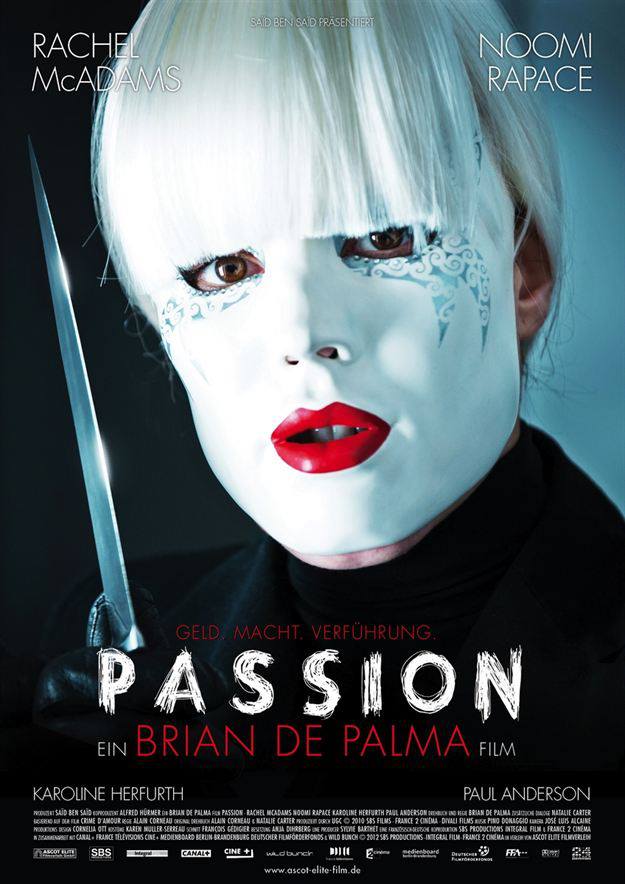 It’s not the throat slittings, strangulations, fetish masks, drug-fueled nightmares or murderous lesbians that make Brian De Palma’s “Passion” so enjoyable. Those things are all quite wonderful, but what’s really special here is that they’re handled so effortlessly. There’s a lightness to “Passion” that I wasn’t expecting, a playful insouciance that informs the entire film, from the first quirky notes of Pino Donaggio’s retro score to the final grisly tableau. I was completely charmed by it.
It’s really two movies for the price of one. The first is a dirty little office comedy about beautiful people stabbing each other in the back to get ahead. The second is a dreamy psycho-thriller about beautiful people slashing each other in the throat to get revenge. Both are a lot of fun.
De Palma’s artfully composed split-screens, prowling steadicam and deep-focus diopter shots help goose an already nifty story into something memorable. Admittedly, the bigger fan you are of the director, the better the film will probably work for you. I love the guy, but your results may vary.
Unlike Bret Easton Ellis’s tone-deaf dialog in Paul Schrader’s otherwise curious “The Canyons,” De Palma’s script is intentionally funny. What a relief! There’s nothing smug or self-important at work here. It never takes itself too seriously, but doesn’t devolve into a joke, either. That’s a delicate line for an erotic thriller to walk, but “Passion” pulls it off quiet nicely.
Rachel McAdams, an actress I’ve never felt strongly about, is terrific as the ethically-challenged corporate honcho whose kinky sex games set the twisty plot spinning. After Rebecca Romijn’s semi-awkward performance in the well-crafted “Femme Fatale” and Scarlett Johansson’s somnambulant interpretation of a human being in “The Black Dahlia,” it’s a pleasure to see De Palma directing someone who appears fully engaged with the camera for a change. McAdams seems almost giddy at times, hungrily chewing as much scenery as she can get her manicured fingers on.
It took me a while to get on Noomi Rapace’s odd wavelength, but once I did her casting made perfect sense. There’s something alien about her, something icy, yet fragile. The darker the story gets, the more comfortable she seems in it. Pairing her with the vibrant McAdams was a great idea, as the two contrast beautifully on screen.
I might be overselling it, but that’s okay. I thoroughly enjoyed “Passion” and look forward to seeing it again (and probably again after that). It’s not a big film. It’s not a baroque horror tale like “Raising Cain,” or a Grand Guignol masterpiece like “Dressed to Kill.” The ending doesn’t make much sense, and I’m not sure if the mystery-plot plays fair with the audience. But it’s stylish, smart and funny, and just eerie enough to make you check your closet before going to sleep afterward.
Variety: 9 Ways Tim Burton’s ‘Batman’ Changed Superhero Movies Forever
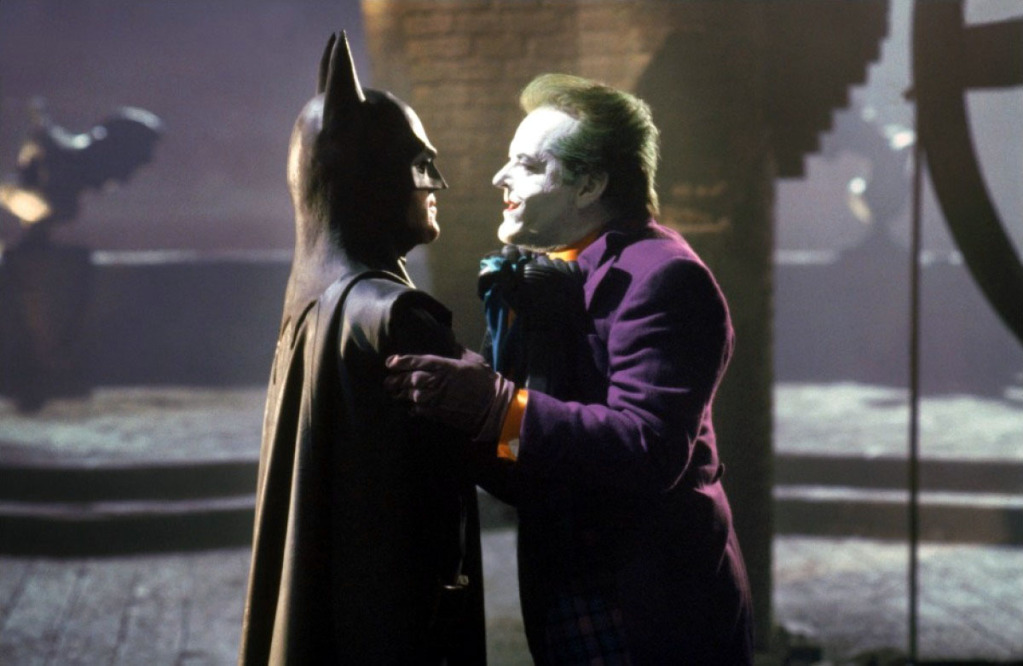
Introduction: It seems difficult to imagine a time when movie screens weren’t packed with comicbook titles, but before June 23, 1989, masked heroes were in short supply. On the 25th anniversary of “Batman,” here’s how the Michael Keaton starrer revolutionized comicbook movies.
Click HERE for slideshow.
William Boyd’s ‘Solo’: A Book Review
 William Boyd’s novel “SOLO” is James Bond by way of Graham Greene, with a bit of the film “The Wild Geese” thrown in for good measure. This is Bond at his most ruminative; a solitary, moody Bond, haunted by dreams of his violent experiences in WWII. The novel opens on a melancholy note, depicting Bond celebrating his 45th birthday alone at the Dorchester Hotel. The mission he’s soon tasked with is a dirty one: fly to the middle of an African civil war, cozy up to a Brigadier whose military successes are prolonging the conflict and “find a way of making him a less efficient soldier.” Polite code for assassination.
This morally and politically complex spy thriller is much closer in spirit to Fleming’s gripping short story “The Living Daylights” than to the pulpy extravagance of “Dr. No.” As expected, Boyd’s writing is razor-sharp, and contrasts nicely with Fleming’s somewhat reserved prose style. That’s not to say he doesn’t follow the Fleming template for adventure, however. The two women in the book couldn’t be more different from each other, or more interesting. The fact that one of them appears to be a thinly disguised version of real-life British horror actress Ingrid Pitt makes this a particularly fun read for fans of Hammer Films.
Aside from the occasional use of the word “fuck,” which never appears in any of the Fleming books, “SOLO” is a pitch-perfect continuation of the classic series. I loved the subtle references to the original novels, as when Bond remembers that the only other time he’d spent in Africa was a brief trip several years before to shoot a helicopter out of the sky (which happened in the final chapter of “Diamonds are Forever), or when Bond is given a new alias and recalls that he used a similar one in the early 1950s when he took a train from New York to Florida (which occurred in “Live and Let Die”).
The lack of a truly epic villain is the only place where the novel stumbles. Kobus Breed, a hideously scarred mercenary given to stringing his victims up with meat hooks, is probably the closest Boyd comes to creating a Fleming-style antagonist. He’s a very good one, scary and realistic, but he’s not on the world-class level of a Red Grant or a Francisco Scaramanga.
Hopefully Boyd will be allowed to continue writing the next few entries in the 007 series, because I suspect he’ll take it in some fascinating directions. Bond could use someone with his skills guiding him into the future.
 Matthew Chernov